Guide
Why does bathroom sealant leak, and is the sealant even the problem?
A leak under a bath is usually one of three things: the sealant joint, the grout, or the plumbing. They produce the same brown patch on a downstairs ceiling and they cost very different amounts to fix, so the diagnosis is worth doing before anybody starts work.
The good news is that you can narrow it down yourself in about twenty minutes with a torch and a towel, and nothing in this article requires a tool you do not already own.
The three tests, in the order worth doing them
Dry the joint completely, then fill the bath to the level you normally would and leave it for an hour without getting in. If water appears below, the leak is under the bath and not at the joint: a filled bath puts no water against the sealant line. That is a plumbing or a waste problem.
Now empty it and run the shower against the wall for five minutes with nobody in the bath, aiming at the tiles rather than the joint. If water appears now, the grout is the suspect, because the water going in is going through the wall face rather than the joint at the bottom of it.
Finally, run water directly along the joint at the point where the bath meets the tile. If that is the run that produces the leak, the sealant is the fault, and it is the cheapest of the three to put right.
What a failed sealant joint actually looks like
It rarely fails in the middle. It fails at one end, almost always the tap end, where the bath flexes most as it fills and empties, and where somebody has stood in it.
Look along the joint at a low angle with a torch rather than straight on. You are looking for a hairline shadow between the silicone and the tile, or the silicone and the bath. A joint can look perfectly white and still be open along a foot of its length.
Push down gently on the bath rim near the tap end and watch the joint. If it opens as the bath moves, the bath is not supported properly underneath, and a new bead alone will fail the same way. That is a bath frame job with a reseal after it, and you should be told that rather than sold a reseal on its own.
When it is the grout, not the sealant
Grout and sealant do different jobs and fail differently. Grout is rigid, it sits between tiles, and it fails by cracking or falling out in short sections. Sealant is flexible, it sits where two different materials meet, and it fails by lifting away along a length.
If the tile face feels cold and slightly damp two or three rows up, or a tile sounds hollow when you tap it, the water is getting in through the wall rather than at the bottom of it. Resealing the bath joint will change nothing.
This is a real repair with a real cost, and it is not the same trade as resealing. If it turns out to be the grout you get told, with what it would take to put right, rather than having a fresh bead run over a problem that is above it.
When it is the plumbing
A waste trap that has been knocked, a shower valve weeping behind the tiles, or an overflow that has never been tightened will all produce a leak that appears when the bath is used and stops when it is not, which is exactly what a failed joint looks like from downstairs.
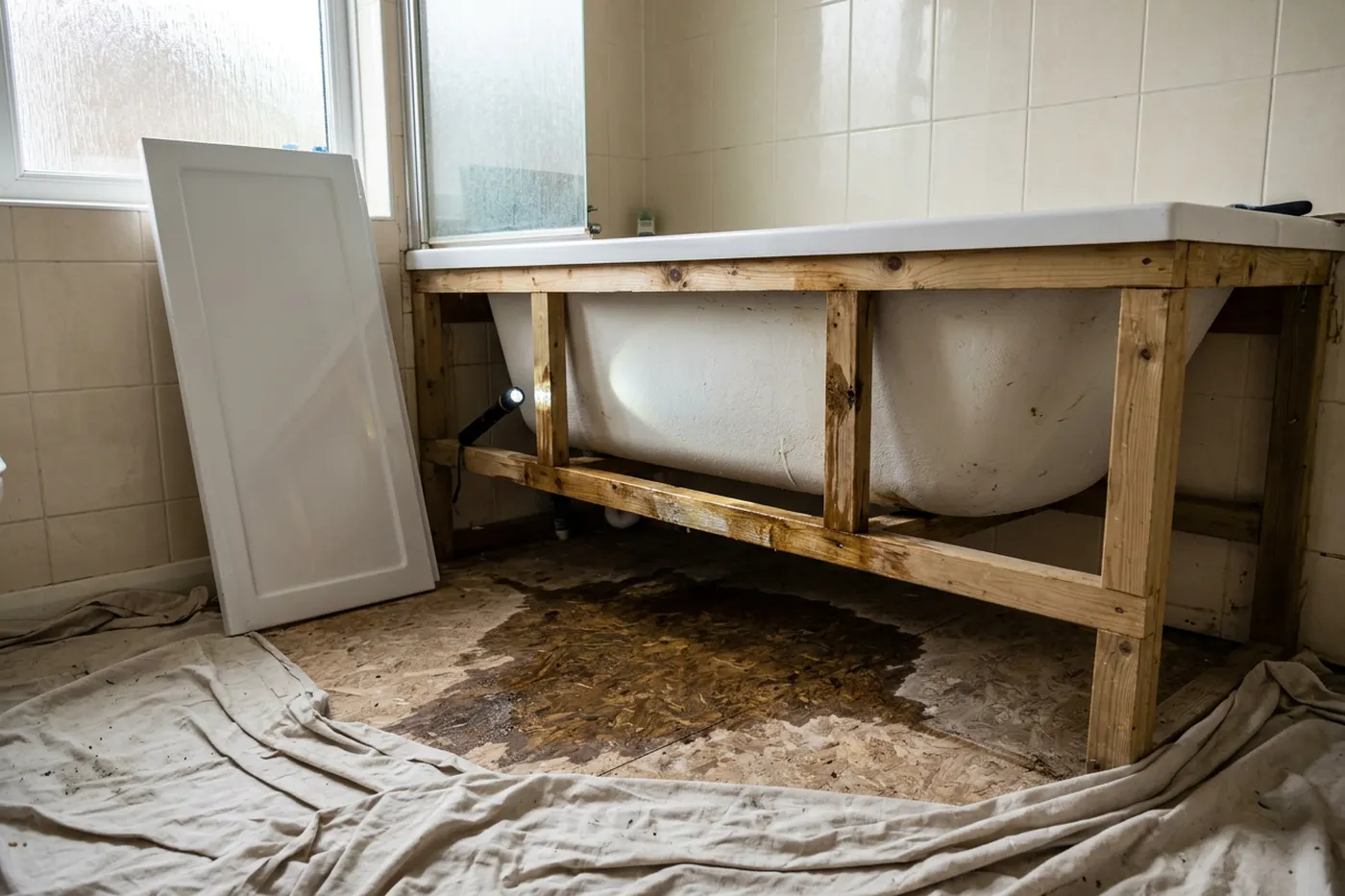
The bath panel is usually four screws. Take it off, put a torch on the floor pointing up at the underside of the bath, and use it while somebody runs water. You will see a drip before you see a stain.
If it is plumbing, it needs a plumber. Sealing over a leak buys a few weeks and then the same patch comes back slightly larger, which is why so many ceilings get painted twice.
Also asked
Related questions
The leak only happens when we shower, not when we bathe. What does that mean?
It points away from the waste and the overflow, because neither is under pressure when the bath is empty. It is usually either the joint at the bottom of the shower run or the grout on the wall the shower hits, and the five minute test above will separate the two.
Can I just seal over the gap until I get it sorted?
It will hold for a few weeks and it will make the eventual repair harder, because there is then another layer to take off. If you need a temporary measure, use the shower over the tray rather than the bath and keep the joint dry.
Do you charge to diagnose it?
No. Send a photograph of the joint and say what you have already noticed and you get an opinion back before anything is booked. If it reads as plumbing or grout rather than sealant you are told that, because a reseal that does not fix the problem is worse than no reseal at all.
If you would rather not
The job this article describes, done for a published price
The pages this covers
- Bath resealing
The old sealant round the bath stripped out completely, the joint cleaned back and dried, and a fresh sanitary bead run and tooled. £95 including VAT and silicone.
- Shower resealing
Tray, base, internal corners and the foot of the screen or enclosure resealed properly, with the old joint taken right out. £95 including VAT and silicone.
The other guides
- Can you reseal a bath or shower without removing the old silicone?
The short answer is no. The longer answer is about what silicone bonds to, and what is living inside the joint you would be covering up.
- Why does bathroom sealant go mouldy, and can it be stopped?
It grows inside the silicone, feeding on soap residue in a joint that never fully dries. What actually slows it down, and what makes no difference.
- How long does silicone take to dry, and when can you use the bath?
Touch dry in under an hour, usable after twenty four. Why those are two different numbers, and what happens if you do not wait.
- Which silicone should go in a bathroom, and does the type matter?
Sanitary grade, not general purpose. Acetoxy on tile and acrylic, neutral cure on stone and metal. White or clear is a choice, and everything else on the shelf is a distraction.
- How often should bathroom sealant be replaced?
There is no fixed interval. There are four signs, and a family bathroom gets through a joint considerably faster than a spare one does.
Get a price
Book a reseal with Exeter Silicone Services
Send a photograph of the joint and say which fittings need doing. Back comes the price off the published card and the next free slot. Ringing is quicker if you want a date fixed today.
- Bath or shower
- £95
- Both on one visit
- £150
- Whole bathroom
- £185
VAT and silicone included. Minimum charge £95.